Build an AI critical thinking tutor that guides students instead of giving answers, with a practical subscription model and path toward $10K MRR.
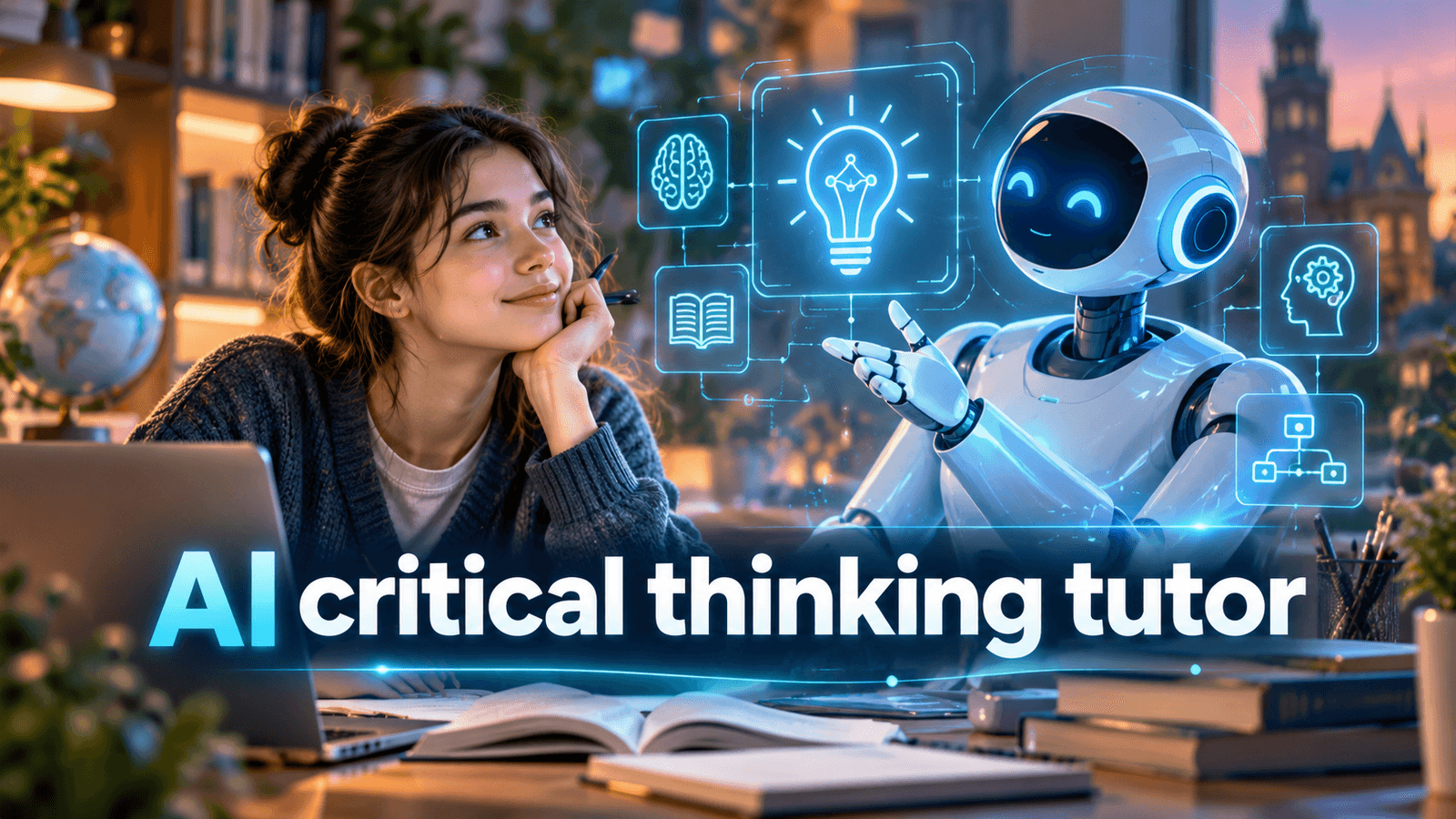
An AI critical thinking tutor could turn a growing education problem into a focused subscription app: students increasingly have access to AI that can complete assignments instantly, while teachers and parents want technology that strengthens reasoning instead of replacing it. The opportunity is to build an AI tutor that deliberately makes learners think before revealing an answer.
An AI critical thinking tutor could turn a growing education problem into a focused subscription app: students increasingly have access to AI that can complete assignments instantly, while teachers and parents want technology that strengthens reasoning instead of replacing it. The opportunity is to build an AI tutor that deliberately makes learners think before revealing an answer.
Why an AI Critical Thinking Tutor Makes Sense Now
The timing is unusually strong. On October 5, 2026, Australia’s federal education department warned about excessive reliance on AI chatbots and potential effects on students’ critical-thinking development. UNESCO also emphasizes human agency and critical thinking in its AI competency framework for education. At the same time, demand for AI-assisted learning is clearly established. Khan Academy’s Khanmigo already guides learners with questions rather than immediately giving answers, while Google’s Guided Learning follows a similar step-by-step philosophy. That means the opportunity is not “another homework chatbot.” The wedge is a critical-thinking-first learning system.
What Should the App Actually Do?
A student enters a question, uploads homework, or selects a topic. Instead of generating the solution immediately, the app asks diagnostic questions, provides progressive hints, requests an explanation in the student’s own words, and unlocks the final explanation only after meaningful effort. The MVP could include Socratic questioning, adaptive hints, reasoning checkpoints, short quizzes, mistake analysis, progress tracking, and parent or teacher summaries.
For entrepreneurs researching adjacent AI opportunities, AI App Space can also be used to explore broader AI-product trends.
How This App Could Make Money
A consumer plan could target parents and students at an illustrative $10–$20 per month, while tutoring centers or schools could pay higher organization-level subscriptions. A possible path toward $10K MRR could be 500 families at $20/month = $10,000/month. Another path could combine household subscriptions with higher-value school or tutoring-center accounts. These figures are business-model scenarios, not revenue guarantees.
The Differentiation That Matters
Existing products prove that guided AI learning has demand, but a startup should narrow its positioning around measurable reasoning habits: How many hints did the learner need? Did they explain the answer themselves? Are they becoming less dependent on assistance? An August 2026 experiment reported by OpenAI found that ChatGPT access and explicit critical-thinking training produced complementary benefits, reinforcing the case for designing AI learning experiences around both assistance and reasoning practice.
Entrepreneurs can also study how professionals currently adopt AI through this guide to AI tools for freelancers.
MVP and 7-Day Validation Plan
Start with one subject, such as middle-school mathematics or science. Build a simple web prototype around an existing AI API rather than developing a broad education platform. Interview 10–15 parents, teachers, or tutors, demonstrate the guided-answer workflow, and ask whether they would pay for it. Then create a landing page, collect early signups, and attempt to secure several paid pilot users before expanding development.
The team behind the project can also explain its mission and technology focus through the AI App Space About page.
How to Find the First Customers
Start with homeschooling communities, tutoring centers, parent groups, independent teachers, and small private schools. Demonstrations should focus on one clear promise: the AI helps the student reach the answer without doing the thinking for them. The largest risk is that general-purpose AI platforms improve their tutoring modes enough to reduce demand for a standalone product. The defense is specialization: deeper progress tracking, curriculum alignment, parent controls, reasoning analytics, and school workflows.
Want This App Built for Your Business?
A focused AI learning platform can start with one subject and one audience before expanding into a larger education product. APPS-hunt.com can help entrepreneurs explore the MVP, AI workflow, monetization model, and validation strategy for a similar app concept.
Want More App & AI Business Opportunities?
Follow Apps Hunt on Instagram, Pinterest, and YouTube for app business ideas, AI tools, SaaS opportunities, and emerging technology trends.
Frequently asked questions
An AI critical thinking tutor is a learning assistant designed to guide students through reasoning, hints, questions, and explanations instead of immediately providing final answers.
A specialized tutor can restrict direct-answer behavior, track learning progress, follow a curriculum, measure reasoning attempts, and provide parent or teacher reporting.
AI can support critical thinking when the learning experience requires students to reason, explain, compare alternatives, and evaluate answers rather than simply copy generated responses.
A focused MVP could begin with mathematics, science, reading comprehension, writing, or exam preparation before expanding into additional subjects.
Possible models include monthly family subscriptions, school licenses, tutoring-center plans, premium learning reports, and organization-level subscriptions.
Pricing depends on the audience and feature set. A founder could test affordable consumer subscriptions alongside higher-value plans for tutoring businesses or schools.
The first version should focus on guided questioning, progressive hints, answer explanations, short assessments, progress tracking, and basic parent or teacher reporting.
Potential customers include parents, homeschooling families, tutors, tutoring centers, private schools, teachers, and education organizations.
A narrow MVP can use existing AI models, authentication, a simple database, and subscription payments. Curriculum quality, safety controls, privacy, and reliable tutoring behavior require more careful development.
It is possible if the product solves a strong recurring problem and retains paying users. For example, 500 customers paying $20 per month would equal $10,000 MRR, but market validation and retention must be proven before treating that as a realistic business outcome.