
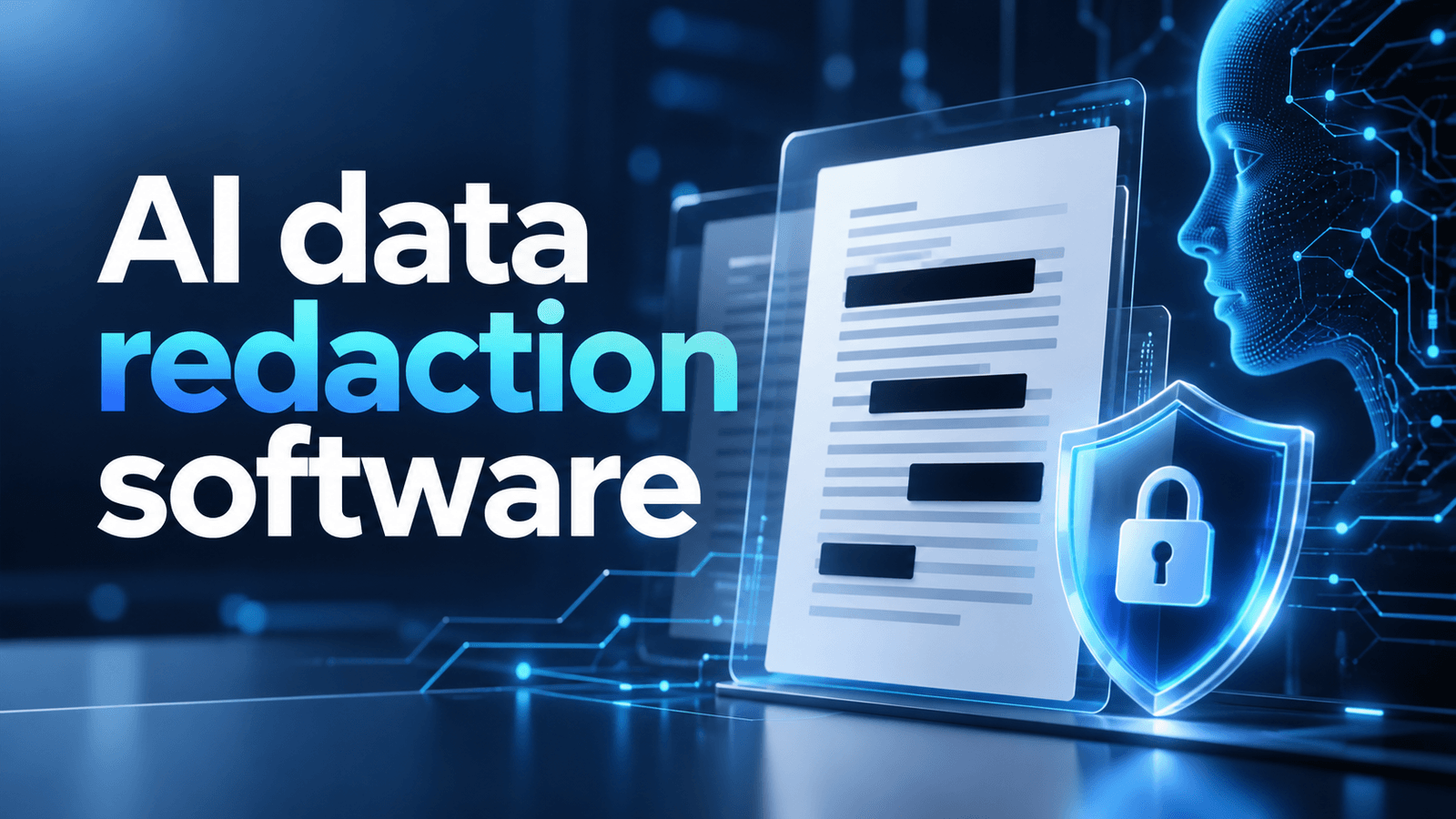
Build AI data redaction software that protects sensitive business data before employees send it to AI tools, with a practical path to $10K MRR.
AI tools save employees time, but they also make accidental data exposure easier. AI data redaction software could detect personally identifiable information, credentials, financial data, customer records, and confidential text before it reaches third-party AI tools. For founders, that creates a focused privacy SaaS opportunity with recurring B2B demand and a plausible path toward $10,000 in monthly recurring revenue.
AI tools save employees time, but they also make accidental data exposure easier. AI data redaction software could detect personally identifiable information, credentials, financial data, customer records, and confidential text before it reaches third-party AI tools. For founders, that creates a focused privacy SaaS opportunity with recurring B2B demand and a plausible path toward $10,000 in monthly recurring revenue.
Why AI Data Redaction Software Is a Timely Business Idea
The market signal is getting stronger. OpenAI released Privacy Filter in April 2026, an open-weight model designed to detect and redact personally identifiable information locally. Microsoft research published in July 2026 found privacy violations in enterprise LLM-agent evaluations, while Netskope reported that 50% of organizations in its 2026 dataset lacked enforceable data-protection policies for generative AI apps. That gap leaves room for an SMB-focused product. Instead of deploying a complex enterprise DLP platform, a business could install a browser extension that scans prompts, pasted text, and uploaded documents before submission.
Founders exploring adjacent opportunities can browse the AI App Space blog for more AI product and automation ideas.
What the AI Data Redaction Software Should Do
The workflow should be simple: an employee opens ChatGPT, Gemini, Claude, Copilot, or another AI service; the extension scans the content; risky fields are masked or replaced with safe placeholders; and the employee approves the sanitized version. An admin dashboard could record policy events, blocked data categories, users, and audit logs. The MVP could detect PII, API keys, passwords, payment details, customer identifiers, contracts, and confidential project names. Configurable rules would let each company define additional sensitive terms.
Who Would Pay for It
Strong initial customers include agencies, accounting firms, recruiters, legal-service businesses, healthcare administration teams, and software companies whose employees regularly move customer information between documents and AI tools. They may pay because accidental disclosure can create security incidents, compliance work, and client-trust problems. The opportunity is not to replace every enterprise security platform. The product wedge is simple deployment plus AI-specific data protection.
For another example of software built around digital protection and monitoring, see the FamilyGuard app on Google Play.
Path to $10K/Month
Illustrative pricing could include:
- Small Team: $29/month
- Business: $79/month
- Advanced: $199/month
A possible scenario is 80 Business customers at $79 plus 19 Advanced customers at $199, producing approximately $10,101 MRR. This is an illustrative target, not a revenue guarantee.
MVP and Validation Strategy
MVP and Validation Strategy
A practical MVP could combine a browser extension, local pattern detection, optional local redaction, a policy dashboard, authentication, and subscription billing.
Interview 15–20 small businesses already using AI tools. Build a clickable workflow demo and test whether security-conscious teams will commit to a paid pilot before developing expensive integrations.
Entrepreneurs looking for additional AI products, tools, and software opportunities can also explore AI App Space.
Want This AI Privacy Tool Built for Your Business?
If your business needs an AI privacy layer that can detect sensitive information, automate redaction, and reduce accidental data exposure, AI App Space can help you explore a similar SaaS or automation solution.
Want More App & AI Business Opportunities?
Follow Apps Hunt on Instagram, TikTok, and YouTube for more AI tools, SaaS opportunities, app business ideas, automation strategies, and emerging technology updates.
Frequently asked questions
AI data redaction software identifies sensitive information in text, prompts, or documents and removes, masks, or replaces it before the data is shared with another system.
Businesses increasingly use AI tools with customer, employee, financial, and operational information. Redaction can reduce the risk of sensitive information being submitted unnecessarily.
Yes. A browser-based solution could scan a prompt before submission and mask sensitive information according to company policies.
It could detect names, email addresses, phone numbers, payment data, account numbers, credentials, API keys, confidential project names, and other organization-defined information.
Traditional DLP covers broader data-loss scenarios. An AI-focused redaction product can concentrate specifically on prompts, uploads, AI applications, and employee AI workflows.
Yes. Local processing is possible. OpenAI’s Privacy Filter, for example, is designed to perform PII detection and redaction locally.
Potential customers include agencies, accountants, legal teams, recruiters, healthcare administrators, developers, consultants, and other businesses handling sensitive client information.
A focused MVP could be relatively lean by starting with a browser extension, predefined detection rules, local processing, a basic dashboard, and subscription billing.
Common models include per-user subscriptions, team plans, business plans, enterprise licensing, advanced policy controls, audit reporting, and paid integrations.
Trust is the biggest challenge. Customers will expect strong security, transparent data handling, accurate detection, low false-positive rates, and clear evidence that the redaction system itself does not create another privacy risk.