
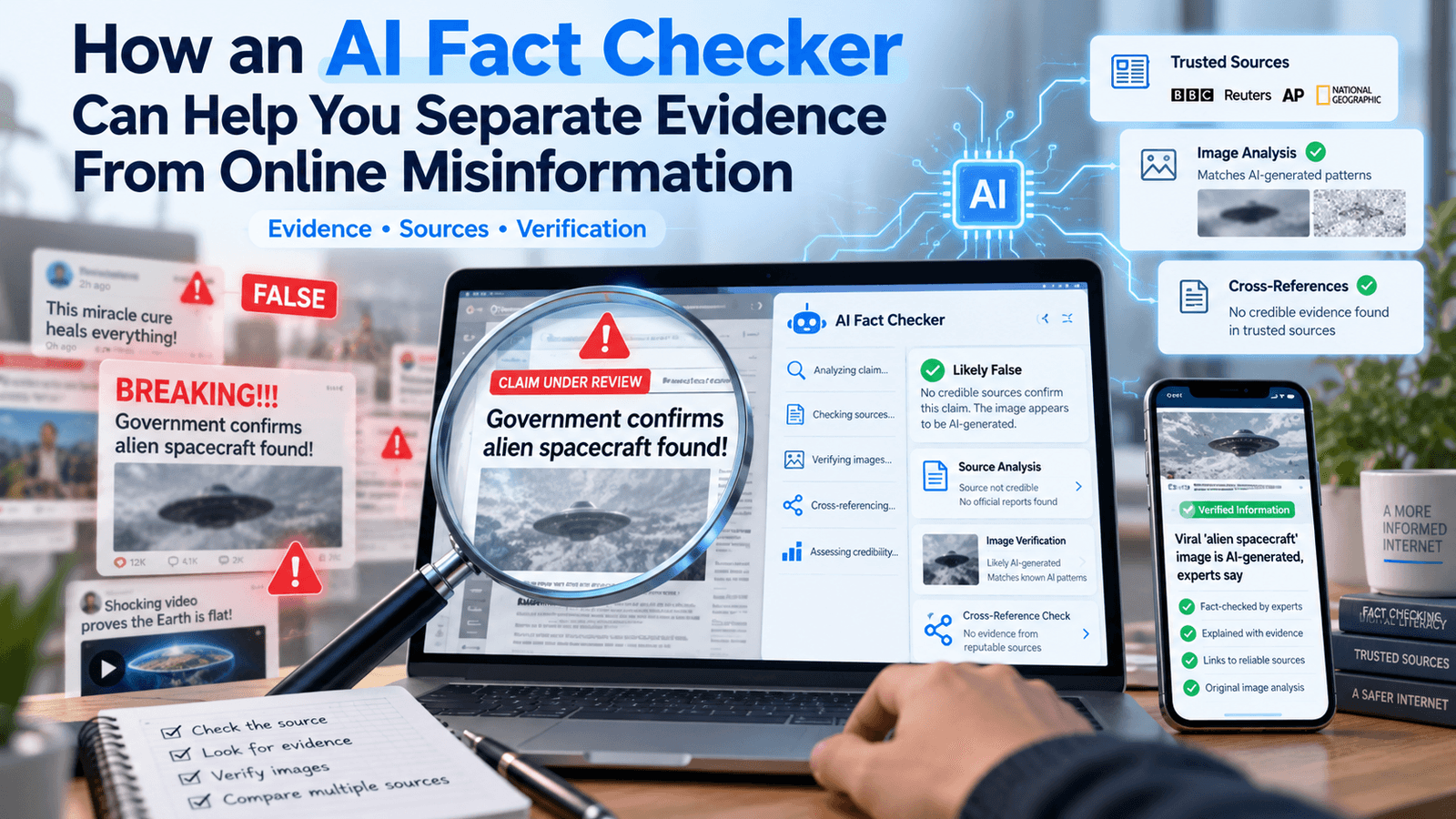
Learn how an AI fact checker can help investigate claims, links, photos and online misinformation while keeping evidence visible to the user.
Artificial intelligence has made it easier to create content, but it has also made online verification more complicated. Real photographs can be edited. Artificial images can look convincing. Fabricated headlines can imitate genuine news outlets. Old videos can be reposted as breaking news. AI-generated text can spread unsupported claims at enormous speed. This creates a growing need for tools that help people investigate what they encounter online. Fact Checker is an AI fact checker designed to help users examine claims and media before deciding whether they should trust or share them.
Artificial intelligence has made it easier to create content, but it has also made online verification more complicated. Real photographs can be edited. Artificial images can look convincing. Fabricated headlines can imitate genuine news outlets. Old videos can be reposted as breaking news. AI-generated text can spread unsupported claims at enormous speed. This creates a growing need for tools that help people investigate what they encounter online. Fact Checker is an AI fact checker designed to help users examine claims and media before deciding whether they should trust or share them.
What Is an AI Fact Checker?
An AI fact checker uses automated analysis to assist with the process of evaluating information. However, this should not be confused with a conventional AI checker or AI detector. An AI detector typically asks whether text appears to have been generated by AI. An AI fact checking tool addresses a different question: What evidence is available for this claim, and how credible does the information appear? That distinction is important. AI-generated information is not automatically false, and human-written information is not automatically accurate. Authorship and factual accuracy are separate questions.
Evidence Is More Valuable Than a Mysterious Verdict
One useful principle behind Fact Checker is its emphasis on showing users findings rather than asking them to blindly accept an answer. The platform describes its approach as checking sourcing, cross-referencing fact-checkers and identifying misinformation signals while giving users a score instead of only a flat verdict. Why does that matter? Suppose an automated system simply says FALSE. You immediately have another question: Why? A useful verification process should help answer that question. Users should be able to understand whether the conclusion relates to the source, existing fact checks, contextual evidence, media analysis or other relevant findings.
Source Reputation Can Reveal Important Clues
One of the signals presented by Fact Checker is Publisher & Domain Analysis. The platform considers whether information originates from an established outlet, a new anonymous account or something in between. Source reputation does not automatically prove whether an individual claim is true, but it provides valuable context. There is an important difference between a report published by an established news organization with transparent editorial standards and an anonymous website created recently with no identifiable authors. A good news verification tool considers that context while still examining the claim itself.
Cross-Referencing Existing Fact Checks
Another useful part of verification is determining whether independent fact-checkers have already examined a claim. Users often manually search terms such as Snopes fact check, Snopes fact checker or Google fact check when they encounter suspicious information. Fact Checker incorporates fact-checker cross-referencing into its verification approach. This can save users time while still allowing them to examine the available evidence.
AI-Generated Media Requires Careful Interpretation
AI-generated content introduces another challenge. Synthetic images, text and video can increasingly resemble authentic content. Fact Checker analyzes AI-generation signals, but the platform presents them as confidence signals rather than absolute certainty. That distinction reflects an important principle of responsible AI use. An AI detector is an analytical signal, not magic proof.
Visual Context Matters Too
Not every misleading photograph is AI-generated. Sometimes the photograph is completely genuine, but the caption is false. An image from an event five years ago could suddenly appear online with a caption claiming that it happened yesterday. Fact Checker includes visual-context verification intended to help determine whether a photo or clip has appeared previously in another setting. This is particularly valuable for social media, where images frequently travel farther than their original context.
Who Can Benefit From an AI Fact Checking Tool?
Almost anyone who consumes online information can benefit. Journalists can use verification tools as part of preliminary research. Students can investigate questionable claims. Businesses can review information before publishing it. Content creators can verify stories before discussing them with an audience. Most importantly, ordinary social media users can check questionable information before amplifying it.
Make Verification Part of Your Online Routine
The internet does not need fewer questions. It needs better ones. Before sharing something, ask: Where did this come from? What evidence supports it? Has anyone independently verified it? Is the photo in its original context? An AI fact checker can make answering those questions easier. Try Fact Checker when you encounter a questionable claim, link, image or video. Technology cannot replace critical thinking, but it can help give critical thinking better evidence to work with.
Frequently asked questions
An AI fact checker is a tool that helps analyze claims, links, images, or other online content by examining available evidence, source credibility, existing fact checks, and misinformation signals.
It can evaluate factors such as source reputation, cross-reference existing fact-checking databases, analyze suspicious media signals, and compare the claim with available supporting evidence.
No. An AI detector mainly estimates whether content was generated by artificial intelligence, while an AI fact checker focuses on whether a claim is supported by credible evidence.
Some AI fact checking tools can analyze visual context, detect possible AI-generation signals, and help determine whether an image or video has appeared previously in a different context.
No automated tool should be treated as completely infallible. AI fact checking tools are most useful when they provide evidence, sources, confidence signals, and context that users can review before reaching a conclusion.